
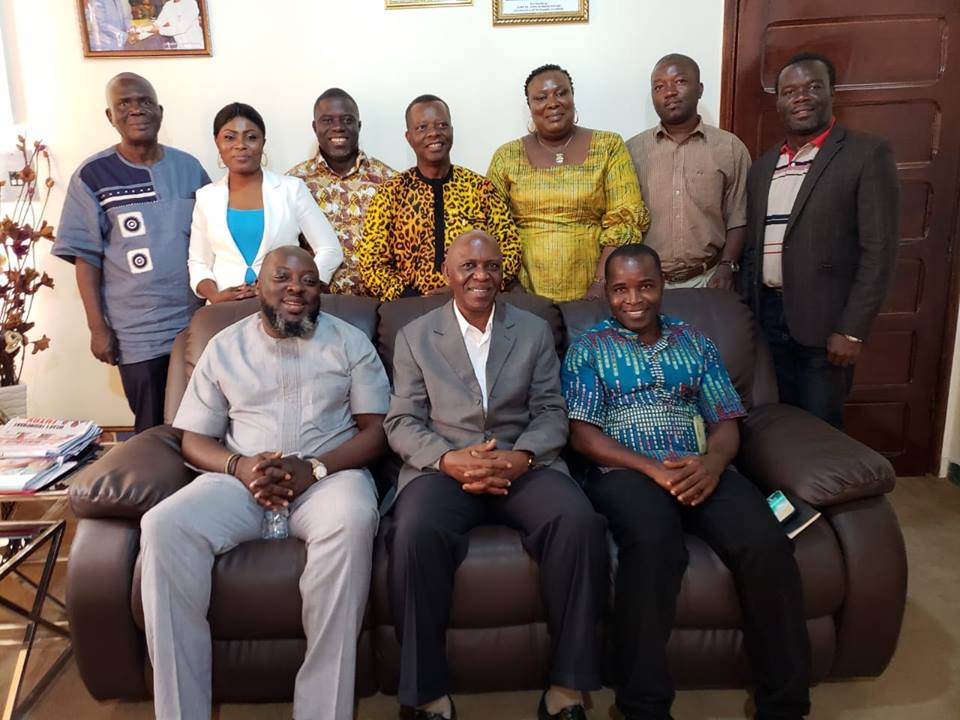
MONROVIA, LIBERIA – The Ministry of Education has concluded this year’s Joint Education Sector Review (JESR) along with stakeholders and partners, a five-day conference that compares the Ministry’s activities with its annual Operation Plan developed to implement the five-year Getting to Best Education Sector Plan.
This year’s JESR was convened under the theme ‘Restoring the education sector for quality outcomes through collective efforts and innovation’. The conference reported the achievements and challenges targeted in the 2018/2019 Operational Plan as well as set the stage for the coming year. Amid various challenges, the Ministry of Education led by Professor Dr. Ansu Dao Sonii, Sr. has made significant gains in prioritizing accountability, strengthen the integrity of the education sector, and improving learning outcomes.
Some milestones…
Development of a National Competency-based Curriculum
With support from the Government of the Kingdom of Sweden and UNFPA, the Ministry of Education has completed the reform of the National Curriculum for Grade 1 to 12, transforming it from content-based to a competency-based curriculum. The National Curriculum, which is the core of quality education, was designed with a mindset to empower learners with social survival skills aimed at thrusting the Country into a middle-income economy.
Through this initiative and support from partners, the Ministry developed the capacity of Task Team members to assist the Center of Excellence for Curriculum Development through the reform process. Additional Educational Diagnostics study was also conducted as part of the plan to upgrade and make functional the Center of Excellence for Curriculum Development. As a result of the diagnostics study, the following activities were implemented and policies also designed, including, the National School Health-Based Health Survey which informed the development of the National Curriculum Policy, the National Curriculum Framework, the National School Health Policy, and the Teacher’s Handbook for Sexuality Education.
WASSCE Tutorial Classes for 12th Graders
Following the release of the 2018 West African Senior Secondary Certification Examinations (WASSCE) results, showing a dismal performance of students in Liberia, the Ministry of Education initiated necessary actions to ensure that students were accorded appropriate assistance that guaranteed improve performance in subsequent examinations. The Ministry of Education launched the WASSCE Intervention Project for both private and public schools with support from the Government of Liberia (GoL). Extra tutorial classes were held across the country in an attempt to boost students’ performances by adequately preparing them for the examinations. Evidently, based on the intervention and compared to the previous year, 12th graders recorded better scores in all subjects, including distinctions in Mathematics and English. About 2,300 students obtained credits in English Language in 2019 verses 508 students in 2018, and about 2,549 students obtained credits in Mathematics in 2019 compared to 197 in 2018, with other subjects registering similar trends.
Increased Access to Early Childhood Education
Through support from partners, the Ministry has rehabilitated several Early Childhood Education level schools in various counties across the country with emphasis on providing better Wash facilities for the Liberian children. Through these interventions supported by partners, the county school systems have also benefited from new hand pumps and latrine facilities.
Secured funding to improve results in secondary education
With the President of the Republic of Liberia, His Excellency George Manneh Weah’s farsightedness in identifying the education sector as a priority agenda, thus attracting funding to improve service delivery, the Ministry of Education in collaboration with the World Bank Task Team Leaders (TTLs) completed the appraisal of a project to improve results in secondary education which eventually led to the approval of a US$47 million International Development Association (IDA) grant to Liberia.
The IRISE project was designed to provide support to the secondary education level of the education systems by applying specific interventions to improve equitable access and learning environment at the senior secondary school, increasing opportunities for girls to transition to and complete secondary school education, improving quality and relevance of senior secondary education building capacity of MoE staff as well as improving the monitoring and evaluation framework of the education system.
Secured Funding for School Feeding programs
Following a travel engagement to Italy by the Honorable Minister of Education, Professor, Dr. Ansu D. Sonii, Sr., to endorse a letter of understanding on behalf of the World Food Program (WFP), a grant to Liberia through the WFP for School Feeding Program and School Health and Nutrition was approved. Through a collaboration, the Ministry of Finance & Development Planning and the World Food Program signed the World Food Programme’s Country Strategic Plan (CSP) 2019-2023 intended to improve the economic growth through enhanced education, improve food security and health relative to the Pro-Poor Agenda for Prosperity and Development (PAPD) pillar 1, 3, and 4, with a budget of 50.2 Million United States Dollars was approved and signed.
Scholarships: Local and International
The Ministry of Education has remained committed to continuing on the path of reforming the education sector by employing mechanisms to improve key outcomes such as increased scholarship opportunities for Liberians. New scholarship sponsored programs have been awarded to both tertiary and technical and vocational students, including sponsorship from France, Morocco, China, among others.
Automating and Improving Financial Processes and Reporting
As part of the action-steps to reforming the financial processes and improving reporting on both government funds and donor-funded projects, the Ministry of Education has completed the automation of its internal financial management and reporting structure using QuickBooks Enterprise software. The transition to an automated financial system resolves all challenges with transparent and accurate reporting of separate projects by the source of funding. The system has given the Ministry the potential to transact, document smoothly, and at the same time, provide timely financial reports to relevant parties.
School Grading
The Ministry of Education, for the first time in the history of the Republic of Liberia, will conduct school assessment and grading using a consolidated digitized tool that is expected to classify all schools, public and private, into categories “A” to ‘F”, with the latter showing the least score. The exercise will ensure that the Ministry can timely and orderly report or share school related data and enrollment statistics.
Closing Supplementary Payroll
Through the harmonization exercise, the previously over 3,000 supplementary teachers have been moved to the regular MoE Payroll registry, and salary adjusted.
Human Resource System
The Ministry has completed the digitization of its Human Resource Management System (HRMIS) as well as provided training for all county human resource officers pending the provision of equipment and rollout of the system in all 15 counties. The HRMIS is intended to improve the system of data management and administration by providing a user-friendly working tool for data sharing from the county level as well as effective ways of coordinating personnel action notices of the entity.
Civics Education
The Ministry of Education has, with immediate effect, reinstroduced the teaching of Civics Education in the curriculum for grade levels across Liberia. This measure caters to one of the fundamental issues of national development, the absence of a full scope implementation of a nationalistic will. It can be recorded that in the past, civics helped fixed some of those behavioral problems and gravitate our young minds to love country first.
Establishing the Center of Excellence
Teacher Licensing and accreditation remain a major target of the current administration of the Ministry of Education, and as a result, steps have been taking to initiate the establishment and making functional its operations. The Center was recently established by the Minister of Education as given by Law to begin planning for the execution of its core duties as prescribed and geared towards improving the system of teachers’ management as well as increase the quality of the teaching workforce. Notwithstanding, the process lacks adequate funding to rollout its full function which is thought after that will be equipped for self-sustainability.
Teachers Training
The quality of the teaching workforce is a fundamental objective of the administration, and as such, several interventions from different partners are in play to achieve the feat.
The Global Partnership for Education Getting to Best in Education project is currently providing teacher training to Early Childhood level teachers within six (6) counties as well as improving the quality of service delivery through technical assistance at the Teacher Training Institutions. The project is also providing additional leadership training for school principals and administrators across the country.
Through the guidance of the Ministry of Education’s team and with the emphasis on teachers and leadership development, there are several teacher training and leadership programs supported by partners, including, the European Union and UNIDO with focus on improving the quality delivery of TVET program, the UNFPA support to the curriculum reform which provided training on the use of the revised curriculum, the USAID Accelerated Quality Education, also providing training skills to teachers in dealing with Overage students and support from the Government of Liberia scholarship initiative through In-service trainings.
Approved Policy for Licensing and Accreditation for Higher Education Institutions
The Minister of Education serves as Head of the Board of the Commission on Higher Education (NCHE) of the Republic and hence, guides the policy decision on major reform. Consolidated efforts were made to develop a policy on Licensing and Accreditation for Higher Education Institutions, which has been approved and sanctioned as a tool to guide the establishment of tertiary level institutions.
Inclusive Education
The Ministry of Education continued its efforts to source resources to support inclusive education and as a result, the World Bank has provided support to the Government of Liberia through the Ministry of Education to assess and fill in key knowledge gaps in disability inclusion in Liberia as a critical step to help the Government implement the Inclusive Education policy and address critical areas of needs and support. Notably, the policy on inclusive education has been approved by the Ministry for the first time since the establishment of the Division for Disability and Inclusive education. Additionally, the Ministry of Education has also completed the conduct of training on Special & Inclusive Education mainstreaming to 40 teachers as add-on to improve teachers’ abilities to identify students with special needs.
In concluding, the Ministry of Education’s team led by Professor Sonii remains optimistic of partners and government’s support to education and confident that these projects will be successfully implemented to achieve the needed outcome of improving the education system.
~END~
Inquiries: phone 1416 or email [email protected]


